Monday, October 31, 2011

Ducks?

I grew up in a place in rural Missouri where waterfowl hunting is a strange and foreign activity that no one understands, nor is particularly interested in, similar to Tai-Chi or football. If we saw a duck while boating down on the Gasconade River, we’d say, “Hey look, guys. There’s a duck!” and that’s about as far as it went.
But duck is on the menu, so duck I will pursue. The first thing to know about waterfowl hunting is that there is a lot you need to know. Consider this unedited excerpt from the waterfowl hunting procedure page on the Missouri Department of Conservation website:
“The Quick Draw System will allocate 80% of the available hunting spots; and the remaining 20% of the hunting spots will be allocated through the “poor line” drawing system. Hunters selected through the Quick Draw System are guaranteed an opportunity to go afield, but are not guaranteed the best locations. Hunters drawn through the Quick Draw system will know their “pill number” prior to arriving at the waterfowl area. Waiting list hunters trying their luck in the “poor line” drawing at Bob Brown, Columbia Bottom, Eagle Bluffs, Grand Pass, Marais Temps Clair, Otter Slough, and Ten Mile Pond Conservation Areas will be using the Every Member Draws (EMD) procedure…”

I would need a mentor. To establish this I once again tapped into Ann’s vast network of contacts, and was connected to Bill Ward. Apparently Bill is to ducks what Chris Morrow is to catfish (see my blog post from August 31, Big Fish on the Mighty Mississipp http://www.woodstofood.com/2011_08_01_archive.html.)
Bill told me what I need to bring (I’m glad he reminded me of the lead prohibition), and said he would see me at the draw on opening morning. The draw is at 5:15 a.m. on opening morning, and Bill said he always gets there at least an hour early. The time he actually gets up to go to the draw is irrelevant to his sleep.
“I can never sleep the night before opening day anyway; I’m too excited,” he said.
This excitement has not faded in Bill not missing a single duck season in the last 50 years. Fifty years! He’s not even 60 years old.
Ann’s Dad scored a pair of waders for me on a garage sale for $2.50, not bad considering new ones cost about $100 and go up (way up) from there. The boot size fits me perfectly, and the body size gives me ample room to pack something about the size of a couple bales of hay in my back pockets.
Considering that my previous waterfowl identification experience is limited to distinguishing between Donald and Daffy, I’m studying information about the fowl that I’m about to pursue. I have a fresh box of #3 steel shot (I didn’t know there was a #3 shot size), and I’m looking forward to what the next weekend has in store.  

Saturday, October 29, 2011

Fish Stories

It’s been a warm October, so we thought we’d better get in some more fishing while we can. We headed back to the same pond on my parent’s farm, only this time we purchased some crickets due to lack of grasshoppers, and Ann’s parent’s joined us.
We got a few bites off the crickets right away, but didn’t get anything hooked. I put fresh ones on the hooks, and started to leave to go on turkey patrol, when Henry hooked and pulled in a nice blue gill. I gave him a hand, and then took off for a quick walk in the woods in attempt to spot a turkey.
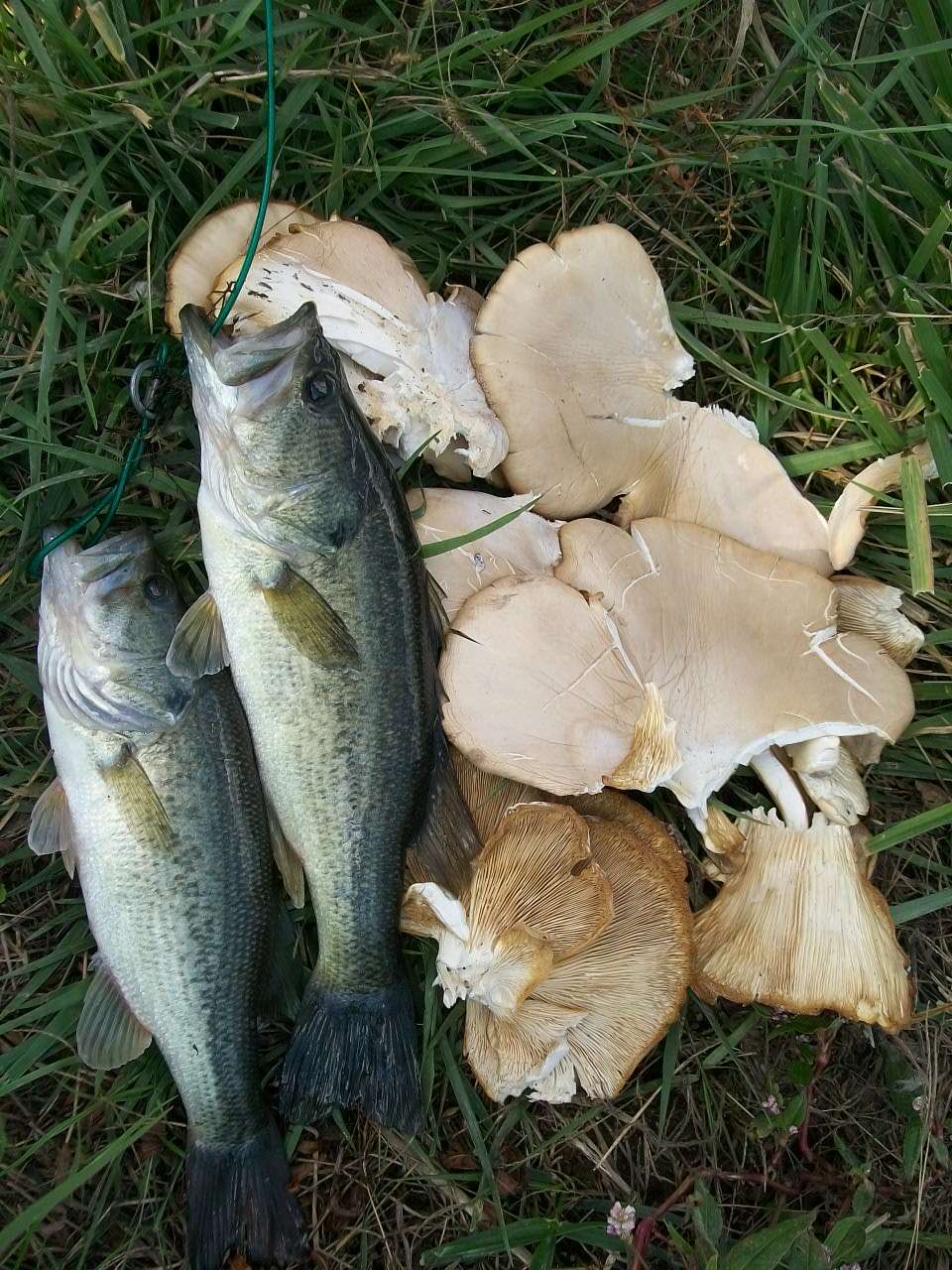
Bass and mushrooms

Ann’s Dad Gerard had caught a bass with a grasshopper lure when we first got there, but then had a lull as he slowly worked his way around the pond. His confidence was high, as a couple weeks before he was fishing in the Bourbuse River and caught a small mouth and large mouth bass at the same time. It was a small lure with a treble hook on both ends, and they both went for it at once, and both got hooked.
I wasn’t gone long, and when I got back Ann and her Mother Ruth were cleaning fish. Gerard had caught four more with his grasshopper lure. But now it was stuck on a limb overhanging the water. Gerard was leaning out for the limb, and Oliver was holding the pole on the other side of the tiny cove. The reel was on the bottom of the rod, and cranked the opposite way that Oliver was used to, so I took it from him, just as Gerard was getting the lure loose. I then reeled the lure in, and caught another bass on the way. The lure was only in the water for probably 10 feet or less, and just a few seconds.
The grasshopper lure had definitely proved itself, and the bite was getting hot, but it was time to head back to Columbia. However, we did now have enough fish on had to tackle some more recipes in Cooking Wild in Missouri.  

Friday, October 28, 2011

Cioppino, page 84

I gots one thing to say tonight. Well, one thing to say emphatically. I love this book! I LOVE COOKING WILD IN MISSOURI !

Tonight my folks came up and I made cioppino out of the book for dinner . It's a spicy seafood/wine/tomato stew using bass, shrimp and mussels in this case. The bass were from our fishing expotition this weekend.

Isn't it so fun to make a meal that people really enjoy? That is surely what took place with the cioppino. Apparently, cioppino was created in San Franscisco pre-WW II by Italian and Portuquese immigrants.  My parents, as luck would have it, love cioppino. Me, I'd never heard of it before. For my parents, who were familiar with the history of the dish, dinner gave them the sense of being in San Francisco at some marvelous restuarant by the ocean. They've attempted cioppino before and thought this recipe rivaled any they've tried. They adored the dinner and couldn't rave on it enough. Weeee.

Which brings me back to how much I like this recipe book. Not only is it encouraging Fred, the boys and me to get outside to hunt and gather more, the actual recipes are introducing us to some really wonderful foods that we haven't been exposed to. And, the recipes are pretty simple, too. They mostly are the kind of thing a person can make as a week day meal without being sorry!

Speaking of having a good night, how about those Cardinals?! Cioppino for dinner, then building a big fire in the fireplace and watching a game like that. Wowee. Can't offer better than that for our dinner guests, die hard Cardinals fans that they are. We are going into game #7 tonight. Hmm. No dinner plans yet. But, whatever it is, I'm pretty sure dinner is going to be secondary to el gamo.


Thursday, October 27, 2011

Unfounded Fall Turkeys

The turkey that was prowling about my wife’s office hasn’t been seen in more than a week. I think he must have read the blog. So instead I took to the woods for firearms season.
Many turkey hunters will tell you they only hunt in the spring, because they enjoy the process of calling in a gobbler and think fall season is too easy. I think most of these hunters probably share the bond of having attempted to fall turkey hunt, only to go home in frustration after failing to find turkeys.
Turkeys move around in groups in the fall. My parent’s farm is a mix of crop fields, open pasture and woods. While there on Saturday my father and I checked behind every bush. No turkeys. I shared this information with my father-in-law, who was planning on hunting there later in the week. “But,” I said so as not to discourage him, “…there could be turkeys there the next week. Shoot there could even be turkeys there the next day.”
Actually, there were turkeys there in the next few minutes. The next morning in church, one of my Dad’s neighbors told him he had to stop in the road to let six turkeys cross. We had seen him on the road. The turkeys were crossing from a neighbor’s property onto our farm, less than five minutes after we had walked through this very small patch of woods (that they crossed into) trying to stir something up. But we didn’t know that until the next day. So the next day we went back, but the woods were again vacant.
I also tried hunting on a conservation area down in that part of the state. I found a bow hunter, and a few deer, but no turkeys.
But turkey hunting is really only fun in the spring anyway.

Wednesday, October 26, 2011

Pasta with Autumn Nut Sauce, pages 124-125

There are several recipes for pasta with nuts in the book. So far we've made penne pasta with nuts and squash, spaghetti with roasted vegies and nuts, and now pasta with autumn nut sauce. This recipe called for shell shaped pasta but while at the store I remembered how I couldn't shut the cabinet door for all the dry pasta I already had in, so I decided to go home and use what I had. Turns out upon further inspection, my pasta shelf was overfloweth with bunches of Asian noodes and just scraps of other kinds, so we ended up with a bit of an odd assortment, but that's ok. I can close the cabinet door now at least and know that I've got to get to crackin' with some Asian recipes soon, too.

We used some two dimensionally shaped green football pasta that I'm sure has a beautiful name that I am not aware of, mixed with a handful of orzo. The sauce for the recipe isn't cooked-it's just an assemblage of pecans, hickory nuts, two hard cheeses, butter, cream and a few other things I'm forgetting, likely. It's a simple dish.

I kind of liked the penne with squash recipe better, I think. Could be the fact that the pasta shape I used worked only medium well with the sauce. Could also be because I chickened out of using the amount of cream called for in the recipe. Speaking of penne with squash, that is the dish we served to the KBIA reporter. The story did air last Friday. You can hear it at http://www.kbia.org/post/clock-october-21-2011 and click on the listen button.

Tuesday, October 25, 2011

Persisting for Persimmons

One thing for sure about this project, help from friends has been key to success.
Ann had found a few persimmons locally, but not nearly enough. The trees she checked had already dropped their fruit, and there weren’t many to be found. There’s a go-to tree on my parent’s farm that always has an abundant crop. I know this not because I have previously harvested persimmons, but because it was always a good place to pick up a track back in my raccoon hunting days. But my dad reported the tree was bare this year.
Luckily, my sister Christy and her husband Mike were at the farm at the same time as us. He knew of a tree at the neighbor’s house where he used to pasture his horses. We went there together, but it was also void of fruit. But he knew one more place: a cattle ranch that he co-manages a few miles up the road had a tree that he had seen laden with fruit just a few days before.
A few miles and a few gates later, the four of us were at the tree that did indeed have a bountiful persimmon crop. Most were still on the tree. We picked what we could from the ground, and then stood on the back of Mike’s truck and picked some more.
It’s our understanding that persimmons aren’t ripe, and are very sour, until they’ve experienced the first freeze. These persimmons had not, and we were debating what to do with persimmons that weren’t tree ripe. Put them on a window sill like tomatoes? Put them in a brown paper bag like peaches?
On the way out of the pasture, we saw Albert, the owner of the ranch. He asked if we had gathered enough for a pie. “Yes, but we’re not sure if they’re good yet,” we replied. “Just put them in the freezer for a little while,” Albert said.
Huh. That makes sense. Just artificially replicate that first hard freeze. So we’re giving that a try. Cooking Wild in Missouri has four persimmon recipes, so I hope that it works.  

Monday, October 24, 2011

Picking Walnuts

I took up walnut gathering at a young age. My friend Travis and I would roam the farm on a three-wheeler, pulling a little trailer that we would fill with bags of nuts, and at the end of the season we would load them all up in the truck and my dad would take us to a local buyer to sell them.
This weekend, about 30 years after Travis and I did our gleaning, I revisited those same trees with Ann and the boys. The trees haven’t changed much. I don’t think any have died, nor have they grown a noticeable amount. Walnuts tend to be an every-other-year crop on most trees, and the five mature walnuts in our yard in Columbia are on an off-year, producing some, but not a lot. And a lack of hickory nuts have put extra squirrel pressure on the walnut trees at our house. So the farm was our next-best option. We didn’t find many under the first trees we checked at the farm, but I kept following my memories to specific trees, and we ended up finding all we wanted.
Walnuts usually sell for about 10 cents per pound hulled. A hulled walnut weighs a lot less than a big green one. To give you an approximate scale, my sister piles the bed of her husband’s Ford F-350 truck high with sacks of walnuts, and can get about $60 worth on one load. She picks up a couple loads a year like that.
The walnuts that grow in Missouri are black walnuts, and are very different than English walnuts. You’re most likely to have encountered their distinctive flavor in black walnut ice cream.
All the walnuts purchased by buyers in Missouri and the surrounding states end up in Stockton, MO, at Hammons Black Walnuts.  Hammons has 250 buying stations, or hullers, in a 16 state area. They sell black walnuts directly to the food industry for products like black walnut ice cream, and even sell the hulls, which are used as an abrasive for polishing metal, as a filter to separate crude oil from water, in cosmetics and in dynamite.
If you don’t want to crack your own nuts, Hammons also has a retail division. You can purchase pure, wild black walnuts from them, or candy-coated nuts at their website www.hammonsproducts.com. The website will also tell you everything you ever wanted to know about walnuts.
Full disclosure, I’m acquainted with Brian Hammons through my employer, the United Methodist Church. Brian is the laity leader for the UMC in Missouri. He volunteers a ton of time to the church, and is an all-around great guy. 
I was happy to share my walnut-gathering heritage with my family this weekend, even if it was a little hard for the boys to stay on task. Come to think of it, Travis and I probably weren’t that speedy back in the day either. I think I remember my split of the take being something around $14 after a season of harvesting.